

The right fix for discoloured teeth depends on whether the stain is on the outside or inside of the tooth. Outside stains come off with a professional clean like EMS Airflow. Inside stains need whitening, composite, or porcelain veneers. At Dental Specialists of Turramurra, our team plans all 3 options under one roof through our Discoloured Teeth Whitening service.
This page is a plain guide. Short sentences. No jargon unless we explain it.
What does it mean when teeth are discoloured?
Discoloured teeth are teeth that are darker, yellower, or more patchy than they used to be. The colour change can come from the outside of the tooth or from the inside.
There are 2 main kinds of stain:
- Extrinsic stain. On the outside. Caused by coffee, tea, red wine, smoking, or just age. It sits on the enamel.
- Intrinsic stain. On the inside. Caused by old fillings, antibiotics in childhood, a knock to the tooth when young, or simply the dentine (the layer under the enamel) yellowing with age.
Knowing which kind of stain you have is the first step. The 2 kinds need very different treatments.
How do I know which kind of stain I have?
Here is a quick test you can do at home. Brush your teeth well. Stand in bright light and look closely. Ask yourself 3 questions:
- Are the edges of the front teeth darker than the middle? Often a sign of intrinsic stain.
- Is the discolouration patchy or one tooth only? That often points to a single tooth problem, like an old root canal.
- Does the discolouration rub off when the hygienist polishes your teeth? If yes, it is extrinsic.
If you are still not sure, our team will tell you at your first visit. We use a shade guide (a set of tooth-shaped colour samples) to measure your starting colour and track how it changes.
What are my 3 main options?
All 3 are real options. Often the best plan combines 2 of them, for example an Airflow clean followed by whitening.
Option 1: EMS Airflow (Guided Biofilm Therapy)
EMS Airflow is a professional clean that uses a fine spray of warm water, air, and a soft powder. It lifts stain, plaque, and biofilm (a thin layer of bacteria) off the teeth. The result is a brighter, fresher smile without bleaching.
There are 3 things that make EMS Airflow different from a normal scale and polish:
- It reaches under the gum gently, which is useful for patients with gum disease.
- It is comfortable for most patients, even those with sensitive teeth.
- It lifts stain that a normal clean leaves behind , especially in the small grooves and between the teeth.
EMS Airflow is the right starting point for any whitening plan. It gets the teeth clean so we can see the true starting colour.
You can read more about our EMS Airflow (Guided Biofilm Therapy) service.
Option 2: Professional teeth whitening
Professional whitening uses a bleaching gel to lighten the dentine underneath the enamel. The gel is either placed in custom trays you wear at home, or applied in the chair for a faster result.
There are 2 main kinds:
- Take-home whitening. Custom trays made from a scan of your teeth. You wear the trays with a low-strength gel for 30 to 60 minutes a day, usually for 2 weeks.
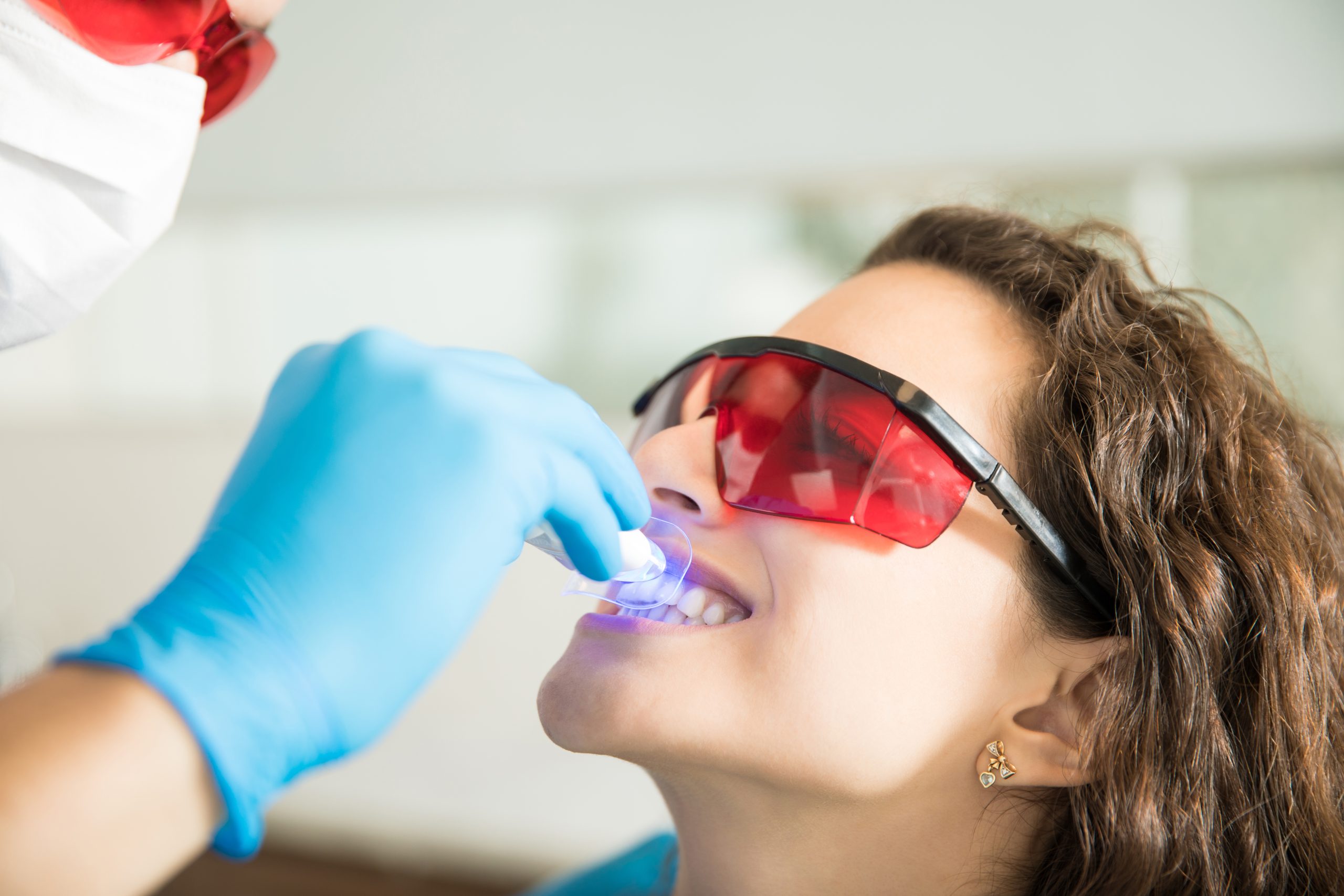
- In-chair whitening. A stronger gel applied in the practice, often with a light to activate it. Takes about 90 minutes.
What whitening can and cannot do
Whitening works well on:
- Yellowing dentine from age.
- Stains from coffee, tea, and red wine that have soaked in over years.
- Mild brown marks from smoking.
Whitening does not work well on:
- White spots. They stay the same shade and can look more obvious.
- Grey stains from old root canals or antibiotics. These need a veneer or a crown.
- Crowns, veneers, and fillings. They do not change colour with whitening.
Option 3: Composite or porcelain veneer for stubborn stain
When the stain is inside the tooth and whitening cannot lift it, we cover the front of the tooth with a thin layer of tooth-coloured material. There are 2 main kinds:
- Composite veneer. A tooth-coloured resin built up on the tooth in one visit. Lower cost, easier to repair, but can stain over time.
- Porcelain veneer. A thin shell of high-strength porcelain made in the lab and bonded to the tooth. Lasts longer and resists stain better.
A veneer takes 1 to 2 visits and gives a long-term result. It is the right fix when the tooth is discoloured and the patient also wants a small change in shape or size.
What is the right plan for me?
The 4-step plan most patients follow:
- EMS Airflow clean. Gets the teeth truly clean and shows the starting colour.
- A shade guide check. We measure where you are now.
- Whitening. If the dentine is yellowing, take-home or in-chair whitening.
- Composite or porcelain veneer. For any teeth that still look dark after whitening, or that have white spots or old fillings.
You do not have to do all 4. We will recommend a plan that matches your goals and your budget.
How long does the result last?
- EMS Airflow: 6 to 12 months. A quick top-up brings it back.
- Whitening: 1 to 3 years. Top-up gels at home can extend it.
- Composite veneer: 5 to 8 years before it may need a polish or a refresh.
- Porcelain veneer: 10 to 15 years, often longer.
The 3 biggest factors are:
- What you eat and drink. Coffee, tea, and red wine stain over time.
- Whether you smoke.
- How well you clean at home.
How much does discoloured teeth whitening cost?
Costs vary depending on which option you choose and how many teeth are treated. We do not publish prices. After your first visit we give a clear written quote.
You can spread the cost with Afterpay, DentiCare, or humm. We accept BUPA, Medibank, and other major health funds.
How do I book?
Call us on (02) 9488 7455 or visit us at Suite 1-2 / 1335 Pacific Highway, Turramurra NSW 2074. We are open Monday to Friday, 9:00 am to 5:00 pm.
You can also read more about our Cosmetic Dentistry service for the full range of cosmetic options.
What is comfort like during treatment?
Our lead prosthodontist, Dr Anthony Au, uses a computerised anaesthetic that numbs you drop by drop for any treatment that needs it. Most whitening and Airflow cleans do not need numbing at all. While we work, you can:
- Watch a DVD on a virtual reality headset.
- Have an aromatherapy eye pack placed over your eyes.
- Listen to music.
- Ask for premedication if you feel anxious.
Afterward, we serve Italian espresso, tea, or a herbal infusion in our lounge.
Frequently Asked Questions
Will whitening damage my enamel?
No. Professional whitening, used as directed, does not damage enamel. Some patients get temporary sensitivity, which settles once treatment ends.
How white can my teeth go?
Whitening lifts your natural shade. The result depends on the starting colour and the cause of the stain. We will show you a realistic expected shade at your first visit using the shade guide.
Can I whiten crowns or veneers?
No. Whitening only works on natural teeth. If you have a crown or veneer that no longer matches, the fix is to replace it, not to whiten it.
How often can I whiten?
Most patients do a top-up once a year or once every 2 years, using their take-home trays for a few nights. In-chair whitening is usually repeated every 2 to 3 years.